
A traveller’s first impression of Greece is usually formed just a few minutes after landing. It is the moment when the aircraft door opens, the bright summer light appears and the journey officially begins.
In the summer of 2026, however, thousands of visitors from outside the European Union may face a very different first experience: a long queue at passport control, a new biometric registration process and waiting times that, at some European airports, have reportedly reached as much as five hours.
At the centre of the issue is the European Union’s new Entry/Exit System, known as EES. It is one of Europe’s largest projects for the digitalisation of its external borders. It was designed to replace manual passport stamps, strengthen security and accurately record who enters and leaves the Schengen Area.
In theory, the objective is simple: more modern, secure and efficient borders.
The reality of the first major summer season under full implementation, however, is proving far more difficult. Airports and airlines warn that the technology, instead of accelerating passenger movement, has in several cases significantly increased the time required for border checks.
For Greece, where many regional airports receive exceptionally high volumes of international arrivals within just a few hours, the problem is not merely technical. It affects the country’s image, passenger safety, the operation of the tourism industry and the entire travel chain that begins at the airport and ends at the hotel or rental car desk.
What Is the New Entry/Exit System?

The EES is a unified European information system for the electronic registration of third-country nationals entering the Schengen Area for a short stay.
Its gradual rollout began on 12 October 2025 across 29 European countries. Following a 180-day transitional period, the system became fully operational on 10 April 2026 at all external border crossing points of the participating countries.
The EES replaces the manual stamping of passports with an electronic record. A file is created for each traveller covered by the system and may include:
- travel document details,
- the date and place of entry or exit,
- a facial image,
- fingerprints,
- records of any refusal of entry.
The system also automatically calculates the permitted duration of stay, helping authorities identify travellers who exceed the legal limit of 90 days within any 180-day period.
Which Travellers Are Affected?

The EES mainly applies to nationals of non-European Union countries travelling to the Schengen Area for a short stay, whether they require a visa or are permitted to travel visa-free.
In practice, this means that visitors from some of Greece’s most important tourism markets are affected, including:
- the United Kingdom,
- the United States,
- Canada,
- Australia,
- Japan,
- Israel and other non-EU countries.
European Union citizens and people who benefit from freedom of movement are not covered in the same way. There are also specific exemptions for certain groups, including some holders of residence permits or long-stay visas.
This distinction is important. Major delays do not necessarily affect every passenger at an airport. They primarily occur in the passport-control lanes used by travellers who must register or verify their details in the EES.
Why the First Registration Takes Longer

The previous process was relatively straightforward. A border officer checked the passport, verified the traveller’s details and added the appropriate stamp.
Under the new system, particularly during a person’s first entry, more steps are required. Travellers must register or verify their personal data, have a facial image captured and, where required, provide fingerprints.
Future crossings should theoretically be faster because the biometric data will already exist in the system and will mainly need to be verified. The initial phase, however, creates a difficult transitional effect: millions of travellers must complete their first registration within a relatively limited period.
This has coincided with the beginning of Europe’s peak summer travel season.
ACI Europe and the International Air Transport Association had already warned before the system became fully operational that existing infrastructure and staffing levels were not sufficient everywhere to absorb the additional processing time.
In February 2026, the organisations reported waiting times of up to two hours, even though the EES was still being applied to only a portion of eligible third-country travellers.
Following full activation, ACI Europe reported cases in which waiting times reached between two and three hours from the first day, even when certain biometric procedures were temporarily bypassed to maintain passenger flow.
From Two Hours to Five

The situation became more serious as summer traffic increased.
In an open letter to the president of the European Commission, leading European airport and airline organisations stated that waiting times had risen substantially following the full implementation of the system in April. During peak periods, they said, queues had reached as long as five hours in extreme cases.
The letter stressed that the issue went beyond inconvenience. Delays have a particularly serious effect on:
- families with young children,
- elderly travellers,
- people with reduced mobility,
- passengers with health conditions,
- travellers with tight flight connections.
The aviation organisations identified three principal causes: insufficient staffing at border-control points, technical problems and the limited use of pre-registration solutions.
The critical issue is that the EES is not simply a new software application that can be installed without changes to physical infrastructure. It requires additional control points, suitable queue-management areas, biometric equipment, technical support and sufficient personnel.
A large airport with spacious facilities may be able to absorb the pressure more easily. At a regional airport designed for a specific passenger capacity and operating under extreme seasonal fluctuations, every additional second per traveller quickly multiplies into a major delay.
Why Greece Is Particularly Vulnerable

The 14 regional airports operated by Fraport Greece handled more than 37.1 million passengers in 2025, compared with approximately 36 million in 2024.
However, this traffic is not distributed evenly throughout the year. In January 2025, these airports served around 664,000 passengers. In July, they handled more than 6.5 million, while in August the total approached 6.8 million.
This means that during the peak summer season, monthly traffic can be almost ten times higher than in the winter months.
The geography of Greek tourism creates even greater pressure. Airports in destinations such as Rhodes, Corfu, Mykonos, Santorini, Kos, Chania and Zakynthos receive large numbers of international flights within very short time windows.
At the same time, a significant proportion of passengers come from the United Kingdom, whose citizens are now treated as third-country nationals at Schengen borders following Brexit.
In July 2025 alone, Fraport Greece’s airports recorded approximately 695,000 passenger arrivals and departures connected with the United Kingdom, making it the largest foreign market in the relevant traffic report.
In early July 2026, Fraport Greece chief executive Alexander Zinell warned that the EES had not been designed around the operational reality of highly seasonal Greek airports. He argued that the process required a complete review and a greater ability for travellers to complete part of their registration before arriving at the border.
When the Queue Extends Outside the Airport
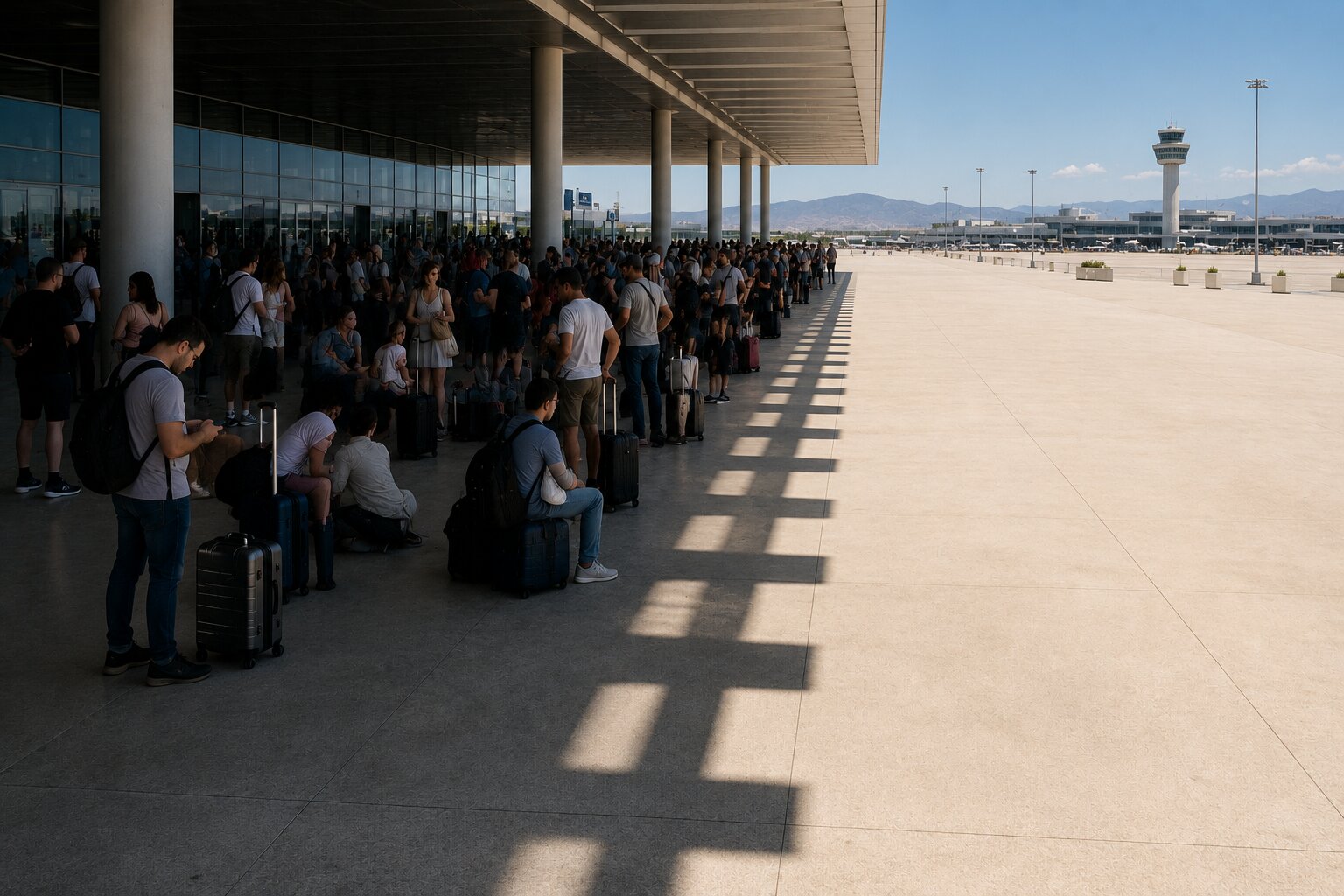
In Greece, the problem has an additional dimension: extreme heat.
When passport-control halls reach capacity, queues may extend into outdoor areas or even towards aircraft parking positions. In temperatures that regularly exceed 35°C, waiting is no longer merely a question of comfort.
It can become a health and safety risk.
Temporary shaded structures have reportedly been installed at some Greek airports, while priority has been given to vulnerable passengers. The head of Fraport Greece described the conditions as not only unpleasant, but potentially dangerous.
This may be the most serious aspect of the issue. A digital security system cannot be considered successful merely because it records data accurately. It must also operate without creating new risks for the people it is designed to serve.
The European Union’s Position

The EES was not introduced without reason. The European Union is attempting to address genuine problems in the management of its external borders.
Manual passport stamping did not always allow authorities to calculate the permitted duration of a traveller’s stay quickly and reliably. It was also more difficult to identify fraudulent travel documents, multiple identities or travellers who had exceeded the legal length of stay.
Through the EES, authorities gain a unified and more accurate digital record of entries and exits. The system is intended to strengthen security, support efforts against irregular migration and eventually make legitimate travel easier.
The European Commission also argues that the passenger experience should improve as more travellers complete their first registration and national authorities adapt their procedures.
There is therefore an important distinction. The criticism from airports is not necessarily directed against the purpose of the EES. It is mainly directed against the way the system has been introduced and the pace of its implementation.
Pre-Registration as a Possible Solution
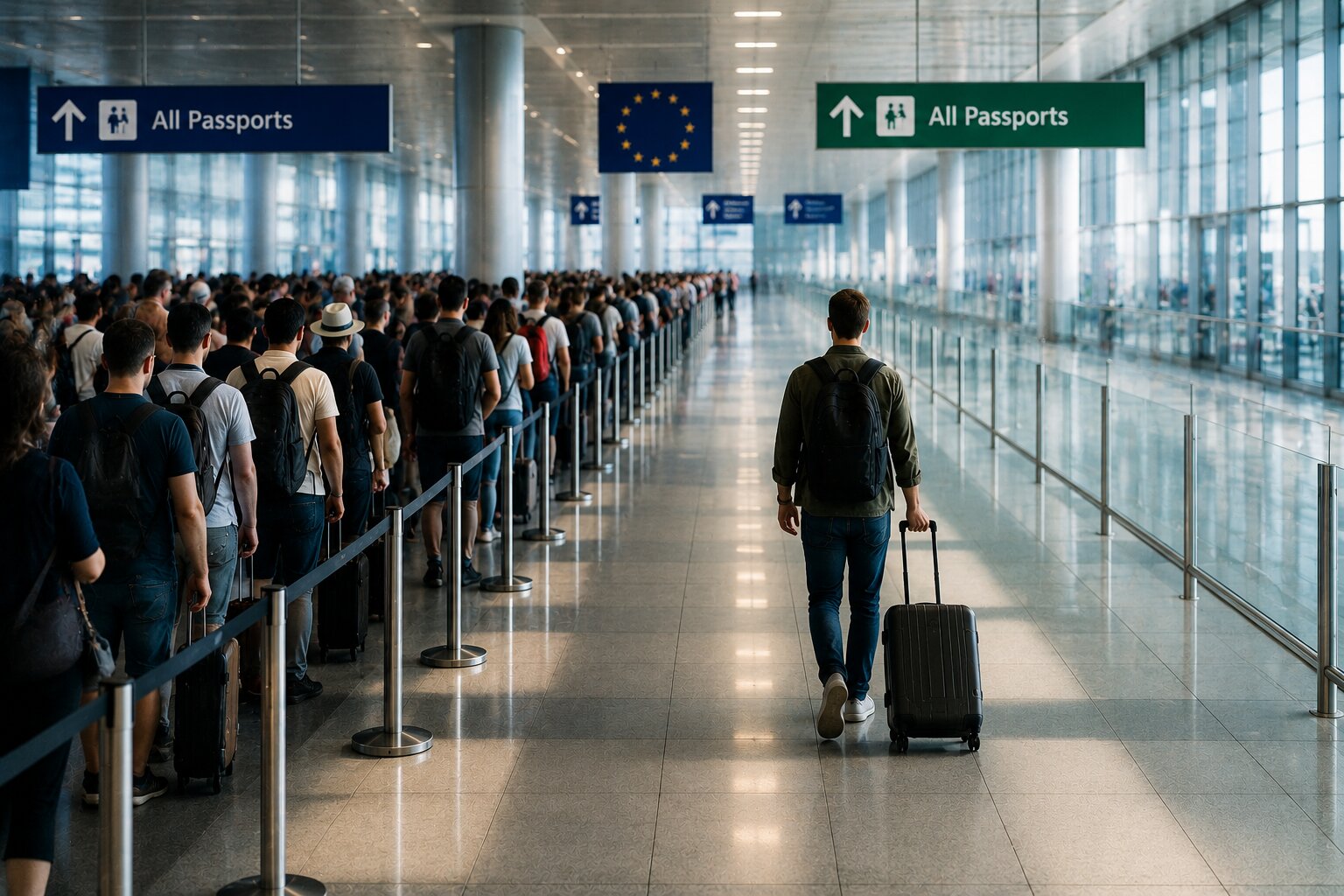
One of the aviation sector’s main demands is for part of the registration process to be moved away from the physical border point.
The European Union has developed the Travel to Europe mobile application, through which travellers may, at border crossings where the service is supported, pre-register passport information, a facial image and details related to entry requirements.
The application does not eliminate the airport border check. It could, however, reduce the number of steps that must be completed directly in front of a border officer.
The problem is that its use remains limited and it is not implemented in the same way across all countries and border points. IATA and ACI Europe have called for wider adoption of pre-registration solutions and greater interoperability between national systems.
The principle is straightforward: anything travellers can complete before departure should not have to be done for the first time in front of a queue of hundreds of people.
The EES Is Not the Same as ETIAS
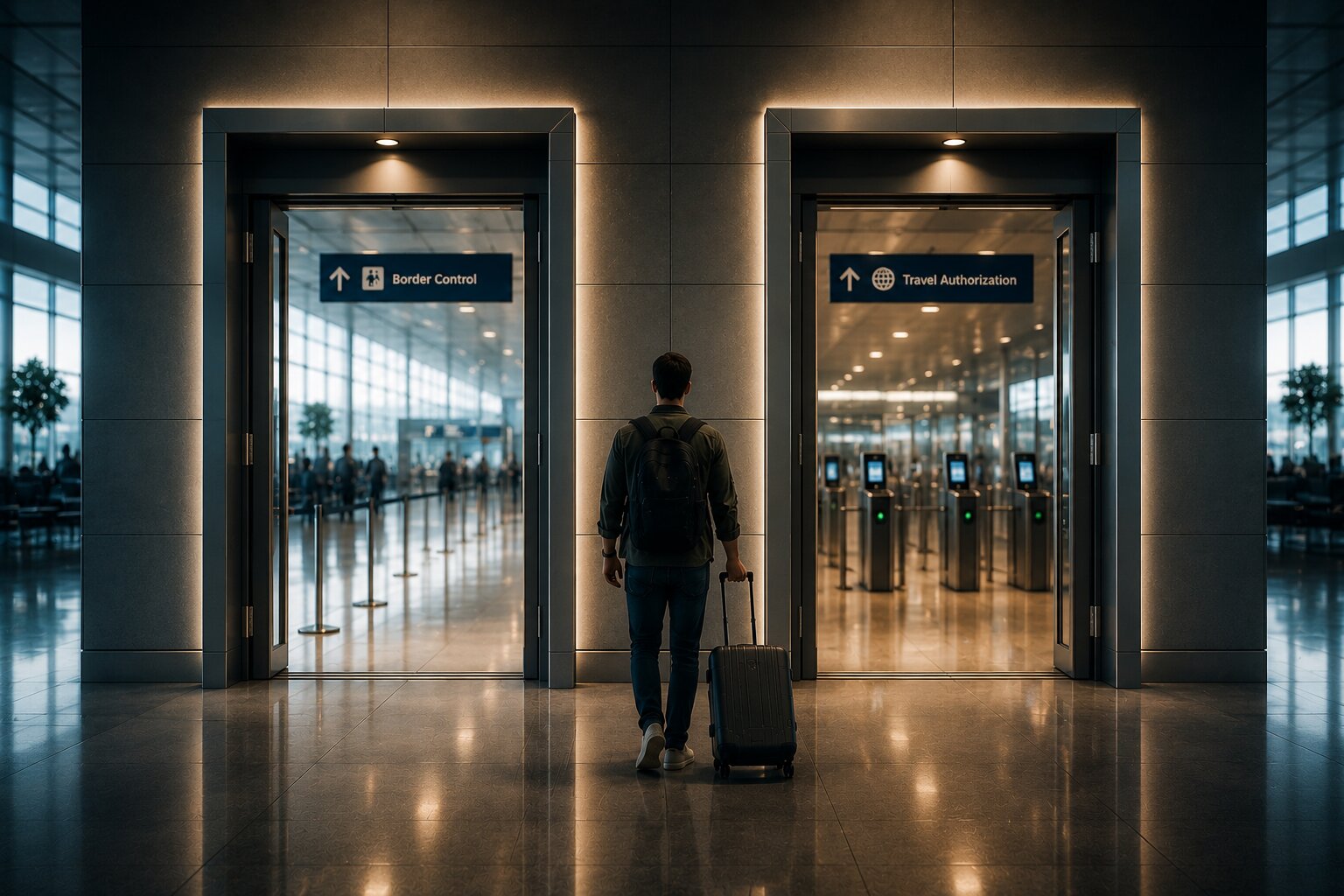
Confusion between the EES and ETIAS is already widespread.
The EES is the system that electronically records a traveller’s entry into and exit from the Schengen Area.
ETIAS is a separate system. It is an electronic travel authorisation that citizens of certain visa-exempt countries will be required to obtain before travelling to Europe.
The EES has already become fully operational. ETIAS should not be confused with the biometric procedure used at border control, and its implementation has been scheduled for a later stage.
This distinction is essential because some travellers incorrectly assume that completing an online travel authorisation will allow them to avoid the EES border-control process.
How the Entire Travel Chain Is Affected

A delay of two or three hours at passport control does not remain confined to the airport. It affects every subsequent stage of the journey.
Hotels and Accommodation Providers
A guest expected to arrive at a hotel at 5:00 p.m. may not appear until 8:00 or 9:00 p.m. This creates difficulties for smaller accommodation providers without a 24-hour reception, affects staff scheduling and increases the number of late-night arrivals.
Transfers and Taxis
A pre-booked transfer may be forced to wait without knowing when the customer will actually exit the terminal. The flight has landed, but the passenger remains trapped in the border-control queue.
Car Rental Companies
Rent-a-car businesses face the same problem. Collection times become unpredictable, particularly when the vehicle is delivered outside the office or by a representative waiting for the traveller.
The delay may lead to:
- additional staff waiting hours,
- congestion when several delayed customers arrive at the same time,
- bookings being moved to later time slots,
- difficulties with vehicle delivery outside normal operating hours,
- customer complaints for circumstances outside the company’s control.
Airlines
The issue may also affect departures when exit checks create significant queues. Passengers who arrived at the airport on time may still reach the gate late, while flights can be delayed if a large number of travellers are held up at border control.
A local delay can therefore spread throughout the wider flight network.
Why the Issue Directly Affects Greek Tourism
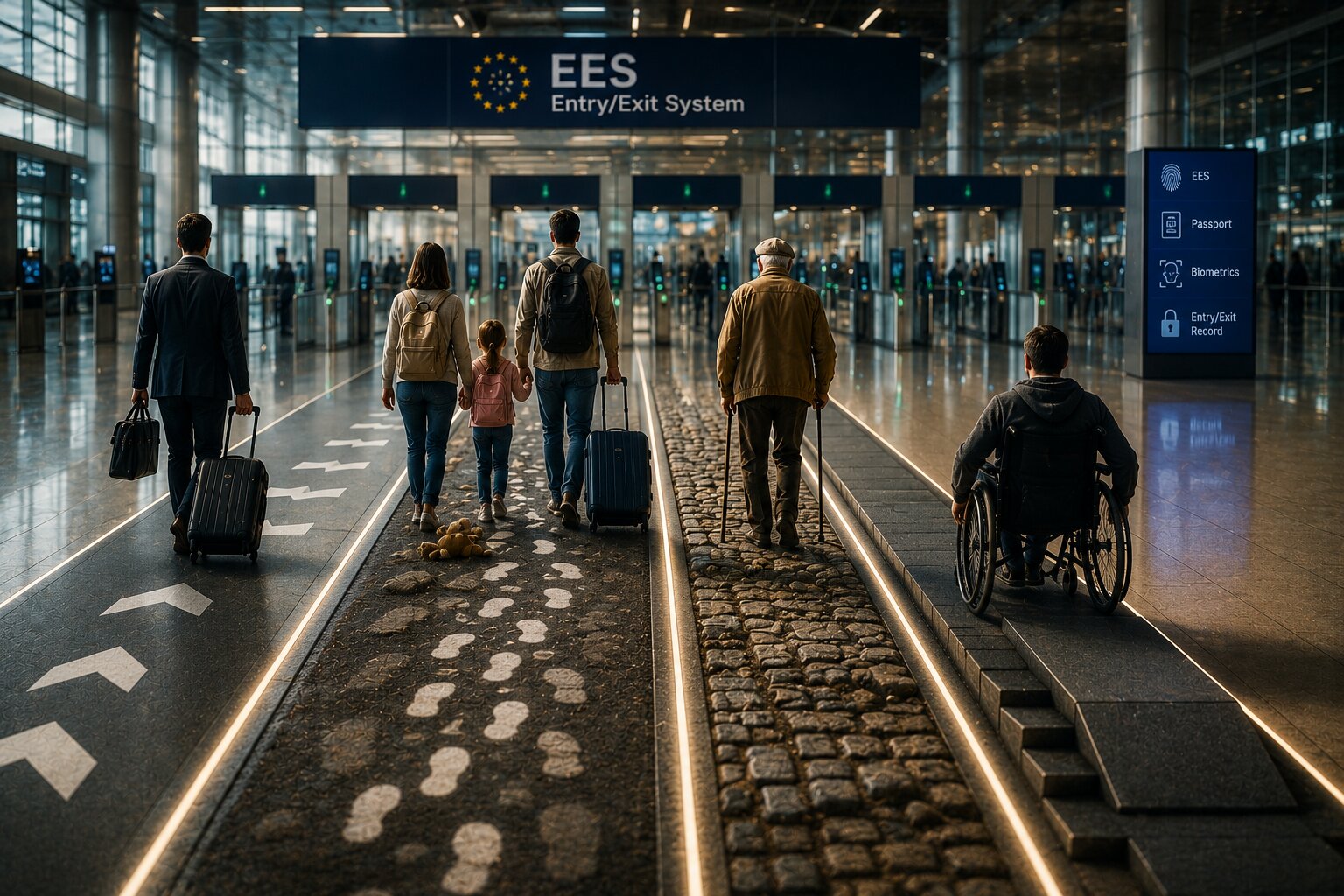
Greece depends heavily on the smooth operation of air arrivals. For many island destinations, the airport is not simply a transport facility. It is the main gateway to the local economy.
Greek travel receipts continued to increase in 2025. During the first seven months of the year, they reached €12.18 billion, representing a 12.5% increase compared with the same period in 2024.
The British market is particularly important. In May 2025 alone, travel receipts from the United Kingdom increased by 8.9%, reaching €314.1 million.
Maintaining this momentum does not depend only on hotel quality or new tourism investments. It also depends on the operation of essential infrastructure.
Travellers experience a journey as a single, continuous process. They do not always distinguish which responsibility belongs to the European Union, the police, the airport operator or the airline.
For them, all of these elements form part of the destination experience.
What Travellers Need to Know

Passengers covered by the EES should be prepared for longer border-control times, especially during their first entry after the system’s introduction.
Useful precautions include:
- checking before travel whether the EES applies to them,
- ensuring their passport is valid and in good condition,
- following airport and airline instructions,
- checking whether pre-registration is available,
- allowing extra time before departure,
- informing the hotel, transfer provider or car rental company about any delays.
Some Greek regional airports have already published notices warning that EES procedures may lead to longer-than-usual waiting times during both arrivals and departures.
Preparation does not solve the operational problem, but it can reduce stress and unrealistic expectations.
The Great Contradiction of Smart Borders

The EES reveals a broader truth about digital transformation.
Technology does not automatically improve a process simply because it replaces paper and passport stamps. To succeed, it must be designed around real human behaviour, available space, staffing levels and peak demand.
A system can be technologically advanced and still be operationally difficult to use.
In the case of Greek airports, the problem is not that biometric technology has no value. The problem is that it is being introduced in facilities with specific physical limitations at the exact moment when passenger traffic multiplies within a few weeks.
Greece cannot afford to treat every airport as though it were a major European hub with stable year-round traffic. Corfu, Rhodes, Mykonos and Santorini have a very different operational reality from the large airports of Central Europe.
The Real Challenge
The question is not whether Europe needs safer and more reliable borders. It does.
The real question is whether it can achieve them without turning the legitimate movement of millions of travellers into a disproportionately difficult process.
The solution will probably not be the complete abandonment of the EES, but a more realistic combination of:
- meaningful pre-registration before travel,
- increased staffing at border-control points,
- more automated border gates,
- stronger technical reliability,
- specific planning for seasonal airports,
- greater flexibility when queues exceed safe limits.
Europe invested in smart borders to make checks more accurate and secure. The summer of 2026 will show whether the system can also become genuinely functional.
For Greece, the issue is even more critical. A visitor’s first impression should not be a queue beneath the summer sun.
Because the quality of a journey does not begin at the hotel, on the beach or in a restaurant.
It begins the moment the traveller crosses the border.
Ready to rent your next car in Greece?
Browse available vehicles on WheelDot, compare options, and book online with flexible pickup choices.
Explore more on WheelDot
Popular destinations for car rental
Planning your next trip? Explore some of the most searched destinations on WheelDot and find the right vehicle for your travel needs.